Meter Networking

A complete office network, delivered as a service.

Meter designs and manufactures the wired, wireless, switching, firewall, and power hardware, then runs it as a subscription: design, hardware, software, operations, and refresh on one invoice. Vega designs, deploys, and manages that stack with you — so a business with fewer than 250 users does not have to own a pile of aging network gear.

Wi-Fi 7 Switches Firewall Power Command ISP sourcing Cellular (US)

Network-as-a-Service

One stack instead of a cart of boxes.

Meter is a vertically integrated networking company. It builds the hardware and the software, then delivers connectivity for a predictable monthly rate rather than a capital project. From Meter’s public product pages, the service is meant to cover routing, switching, wireless, security, DNS security, VPN, SD-WAN, ISP management, and — in the United States — indoor cellular.

Hardware Meter designs and builds

  • Wireless access pointsIndoor and outdoor Wi-Fi 7, tri-band on 2.4, 5, and 6 GHz. Meter says networks are designed by Wi-Fi experts and over-provisioned for the space. If an access point fails, neighboring access points can increase coverage automatically.
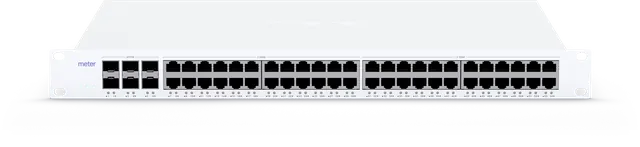
  • Switches12-, 24-, or 48-port multi-gig configurations with PoE++. Built for multi-site operations and managed with the rest of the stack, not as a separate product line.
  • Security appliance / firewallMeter firewalls are built in-house, with published throughput options of 20 and 50 Gbps and built-in high availability. MultiWAN supports automatic failover, active-active connections, and policy-based routing. Firewalls include backup LTE so support can still reach the site if the ISP path is down.
  • Power distributionMeter PDUs give visibility into power use and let you cycle individual outlets from the dashboard. Published units include six 120V outlets.

Software, security, and connectivity

  • Dashboard and CommandThe Meter dashboard covers clients, host monitoring, logs, topology, floor plans, rack elevations, and multi-site management. Meter Command is a natural-language layer on top of that stack: you can ask about a device, take an action, or generate a custom dashboard. Meter says your network data stays in its environment and is not shared with third parties.
  • Network securityMeter describes a next-generation firewall with a default-deny, zero-trust style posture, microsegmentation, DNS security, AutoVPN, a captive portal, and IPsec tunnels. The Professional stack also includes intrusion detection and prevention (IDS/IPS), SD-WAN, and VPN. Authentication options listed by Meter include WPA2, WPA3, PMF, and 802.1X, plus rogue AP detection and guest isolation with rotating passwords.
  • Everyday network controlsVLANs, SSIDs, radio profiles, RADIUS, NAT, port forwarding, and bulk policy updates from one place — including the usual guest-network setup.
  • ISP sourcing with Meter ConnectMeter will work with your current internet provider or help find another, negotiate rates, coordinate installation, troubleshoot with the carrier, and put connectivity on the same invoice as the network.
  • Meter Cellular (United States)Indoor cellular from the major carriers, installed over CAT6 instead of a traditional distributed antenna system. Meter states this is available in the US.

The hardware

The right hardware. One connected network.

Explore the building blocks of your Meter network. We select the mix around your space, your team, and the way you work.

Wireless

Reliable Wi-Fi for the people, devices, and spaces that keep your business moving.

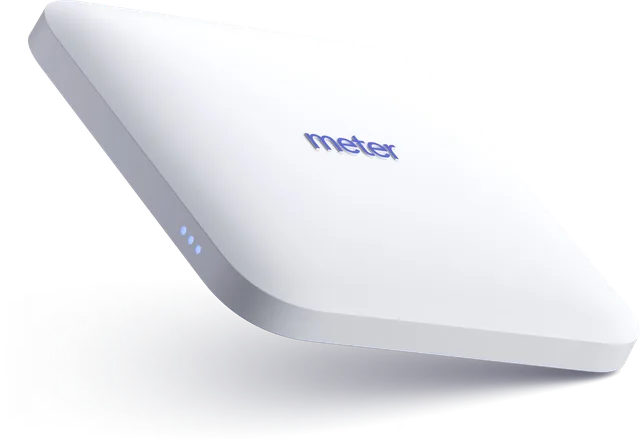
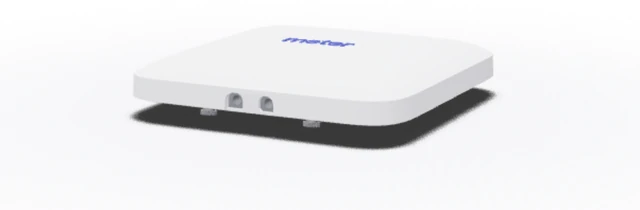
Meter A1 indoor wireless access point

Indoor wireless access point

Meter A1

Best for: High-demand indoor offices and shared spaces.

  • Wi-Fi 7; 2×2 tri-band 2.4/5/6 GHz
  • 1× 2.5GbE RJ-45 uplink
  • 802.3at PoE+ input; maximum 30 W
  • 2.5 Gbps throughput
Datasheet (PDF) for Meter A1 (opens in a new tab)
Full specs 15 specification groups

Scroll for all specifications

Meter A1 full hardware specifications
Radios
  • Wi-Fi 7
  • Tri band operation with scanning radio
  • 6GHz radio
    • 802.11be, 802.11ax
    • 2×2 with two spatial streams
    • Supported channel width: 20MHz, 40MHz, 80MHz, and 160MHz
    • Supports extremely high throughput (EHT)
  • 5GHz radio
    • 802.11be with backward compatibility
    • 2×2 with two spatial streams
    • Supported channel width: 20MHz, 40MHz, 80MHz and 160MHz
    • Supports extremely high throughput (EHT)
  • 2.4GHz radio
    • 802.11be with backward compatibility
    • 2×2 with two spatial streams
    • Supported Channel width: 20MHz
    • Supports extremely high throughput (EHT)
  • 6GHz + 5GHz + 2.4GHz scanning radio
    • 802.11be with backward compatibility
    • 2×2 with two spatial streams
    • Omnidirectional antenna
  • 2.4 GHz IoT radio
Supported modulations
  • 802.11b: BPSK, QPSK, CCK
  • 802.11a/g/n: BPSK, QPSK, 16-QAM, 64-QAM
  • 802.11ac: BPSK, QPSK, 16-QAM, 64-QAM, 256-QAM
  • 802.11ax: BPSK, QPSK, 16-QAM, 64-QAM, 256-QAM, 1024-QAM
  • 802.11be: BPSK, QPSK, 16-QAM, 64-QAM, 256-QAM, 1024-QAM, 4096-QAM
Transmit power (maximum value governed by country regulations)
  • United States (FCC)
    • 2.4 GHz: 31 dBm EIRP
    • 5 GHz: 33 dBm EIRP
    • 6 GHz: 26 dBm EIRP
  • European Union & United Kingdom (CE, UKCA)
    • 2.4 GHz: 19.5 dBm EIRP
    • 5 GHz: 29 dBm EIRP
    • 6 GHz: 22.5 dBm EIRP
Supported data rates (Mbps)
  • 802.11b: Up to 11 Mbps
  • 802.11a/g: Up to 54 Mbps
  • 802.11n: Up to 300 Mbps (MCS0 to MCS15)
  • 802.11ac: Up to 1733 Mbps (MCS0 to MCS9, NSS=1 to 2)
  • 802.11ax:
    • 2.4GHz: Supports up to 286 Mbps (MCS0 to MCS11, NSS=1 to 2)
    • 5GHz: Supports up to 1200 Mbps (MCS0 to MCS11, NSS=1 to 2)
  • 802.11be:
    • 6GHz: Supports up to 2800 Mbps (MCS0 to MCS13, NSS=1 to 2)
Power source
  • PoE+ In, 802.3at , Max power draw 30 W
Integrated antenna
  • Wi-Fi
    • 2.4GHz: 4.7 dBi
    • 5GHz: 5.3 dBi
    • 6GHz: 6.2 dBi
  • Scanning Radio
    • 2.4GHz: 4.7 dBi
    • 5GHz: 5.3 dBi
  • IoT radio: 4.4 dBi
Networking interface
  • 1× 2.5GbE (2.5G/1G/100M/10M) RJ-45
LED indicators
  • 3 independent state LEDs (RGB+W)
Sensors
  • Temperature, Humidity
Dimensions (W × D × H)
  • 200 × 200 × 36 mm
Weight
  • 812.6 g / 1.79 lbs (without accessories)
Operating
  • Temperature: 0°C ~ 45°C
  • Humidity: 0% ~ 90% typical
Compliance standards
  • USA (FCC)
    • EMC
      • Part 15B
      • Class B
    • Radio
      • Part 15C
      • Part 15E (LPI only for 6 GHz)
  • Canada (ISED)
    • EMC
      • ICES-003, Issue 7
      • Class B
    • Radio
      • RSS-247
      • RSS-248
  • EU (CE, RED)
    • EMC
      • EN 61000-6-1
      • EN 301 489-1
      • EN 301 489-17
      • EN 55032
      • EN 55035
      • EN 61000-3-2
      • EN 61000-3-3
    • Radio
      • EN 300 328 v2.2.2
      • EN 301 893 v2.1.1
      • EN 303 687 v1.1.1
      • EN 50385:2017
    • Security
      • EN 18031-1:2024
      • EN 18031-2:2024
  • UK (UKCA, OFCOM)
    • UKCA, OFCOM
  • Australia & New Zealand (RCM, ACMA)
    • EMC
      • CISPR32
    • RF
      • AS/NZS 4268
Safety and restricted materials
  • CB
    • EN IEC 62368-1 edition 3
    • AS/NZS 62368.1
  • UL/CSA
    • UL 62368-1 edition 3
  • RoHS
    • EN IEC 63000:2018
IoT Radio
  • Capability coming soon with software upgrade
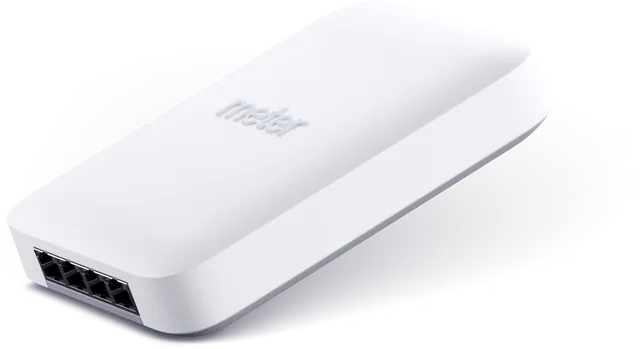
Meter A2 wall-plate wireless access point

Wall-plate wireless access point

Meter A2

Best for: Hospitality rooms and spaces needing in-room wired ports.

  • Wi-Fi 7; 2×2 tri-band 2.4/5/6 GHz
  • 1× 2.5GbE + 4× 1GbE RJ-45
  • 802.3bt PoE++ input; maximum 60 W
  • 1× 802.3af PoE output; maximum 15.4 W
Datasheet (PDF) for Meter A2 (opens in a new tab)
Full specs 10 specification groups

Scroll for all specifications

Meter A2 full hardware specifications
Radios
  • Tri band operation with scanning radio
  • 6 GHz radio
    • 802.11be, 802.11ax
    • 2×2 with two spatial streams
    • Supported channel width: 20 MHz, 40 MHz, 80 MHz, and 160 MHz
    • Supports extremely high throughput (EHT)
  • 5GHz radio
    • 802.11be with backward compatibility
    • 2×2 with two spatial streams
    • Supported channel width: 20 MHz, 40 MHz, 80 MHz and 160 MHz
    • Supports extremely high throughput (EHT)
  • 2.4 GHz radio
    • 802.11be with backward compatibility
    • 2×2 with two spatial streams
    • Supported Channel width: 20 MHz
    • Supports extremely high throughput (EHT)
  • 6 GHz + 5 GHz + 2.4 GHz scanning radio
    • 802.11be with backward compatibility
    • 2×2 with two spatial streams
    • Omnidirectional antenna
  • 2.4 GHz IoT radio
Supported modulations
  • 802.11b: BPSK, QPSK, CCK
  • 802.11a/g/n: BPSK, QPSK, 16-QAM, 64-QAM
  • 802.11ac: BPSK, QPSK, 16-QAM, 64-QAM, 256-QAM
  • 802.11ax: BPSK, QPSK, 16-QAM, 64-QAM, 256-QAM, 1024-QAM
  • 802.11be: BPSK, QPSK, 16-QAM, 64-QAM, 256-QAM, 1024-QAM, 4096-QAM
Supported data rates (Mbps)
  • 802.11b: Up to 11 Mbps
  • 802.11a/g: Up to 54 Mbps
  • 802.11n: Up to 300 Mbps (MCS0 to MCS15)
  • 802.11ac: Up to 1733 Mbps (MCS0 to MCS9, NSS=1 to 2)
  • 802.11ax:
    • 2.4 GHz : Supports up to 286 Mbps (MCS0 to MCS11, NSS=1 to 2)
    • 5 GHz : Supports up to 1200 Mbps (MCS0 to MCS11, NSS=1 to 2)
  • 802.11be:
    • 6 GHz : Supports up to 2800 Mbps (MCS0 to MCS13, NSS=1 to 2)
Power source
  • PoE++ In, 802.3bt , Max power draw 60 W
  • PoE out , 802.3af , Max power draw 15.4 W
Networking interface
  • 1× 2.5GbE (2.5G/1G/100M/10M) RJ-45
  • 4× 1GbE (1G/100M/10M) RJ-45
LED indicators
  • 3 independent state LEDs (RGB+W)
Sensors
  • Temperature, Humidity
Dimensions (W × D × H)
  • 164 × 121 × 36 mm
Weight
  • To be published
Operating
  • Temperature: 0°C ~ 45°C
  • Humidity: 0% ~ 90% typical
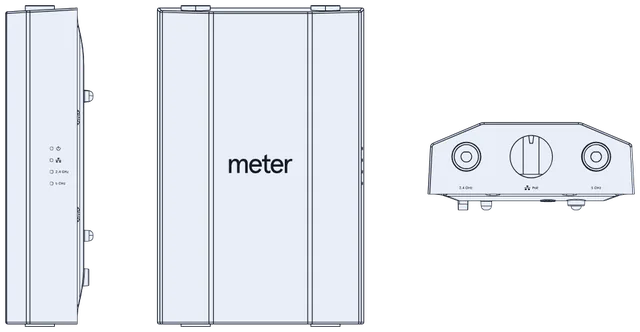
Meter MW09 outdoor wireless access point

Outdoor wireless access point

Meter MW09

Best for: Outdoor coverage such as patios and exposed areas.

  • Wi-Fi 6; 2×2 on 2.4 and 5 GHz plus scanning radio
  • 1× 2.5GbE RJ-45
  • IP67; operating temperature 0–60°C
  • 802.3at or passive 48–54 V PoE input; 12 V DC input
Datasheet (PDF) for Meter MW09 (opens in a new tab)
Full specs 15 specification groups

Scroll for all specifications

Meter MW09 full hardware specifications
Radios
  • Wi-Fi 6 (802.11ax)
  • Tri-radio
    • 5GHz radio
      • 802.11ax + 802.11ac Wave 2 + 802.11 g/n
      • 2×2 with two spatial streams
      • OFDMA + OFDM
      • Supported channel width: 20MHz, 40MHz, 80MHz
      • Supports very high throughput (VHT-HE)
    • 2.4GHz radio (802.11ax)
      • 802.11ax + 802.11ac Wave 2 + 802.11 g/n
      • 2×2 with two spatial streams
      • OFDMA + OFDM
      • Supported Channel width: 20MHz, 40MHz
      • Supports very high throughput (VHT40)
    • 5GHz + 2.4GHz scanning radio
      • 802.11ac + 802.11 g/n
      • 1×1 with one spatial stream
  • Dual band operation: 5GHz and 2.4GHz
  • SU-MIMO and MU-MIMO
  • Omnidirectional antenna
  • 2.4 GHz IoT radio
Supported modulations
  • 802.11b: BPSK, QPSK, CCK
  • 802.11a/g/n: BPSK, QPSK, 16-QAM, 64-QAM
  • 802.11ac: BPSK, QPSK, 16-QAM, 64-QAM, 256-QAM
  • 802.11ax: BPSK, QPSK, 16-QAM, 64-QAM, 256-QAM, 1024-QAM
Transmit power (maximum value)
  • 2.4GHz: 22dBm
  • 5GHz: 25dBm
  • Maximum power is limited by regulatory domain
Supported data rates (Mbps)
  • 802.11b: 1, 2, 5.5, 11
  • 802.11a/g: 6, 9, 12, 18, 36, 48, 54
  • 802.11n: 6.5 to 600 (MCS0 to MCS15)
  • 802.11ac: 6.5 to 867 (MCS0 to MCS9, NSS=1 ~ 2)
  • 802.11ax:
    • 2.4GHz: 9 to 574 (MCS0 to MCS11, NSS=1 ~ 2)
    • 5GHz: 18 to 1201 (MCS0 to MCS11, NSS=1 ~ 2)
Power source
  • DC IN 12V
  • IEEE802.3at or passive 48-54v PoE input (2.5GbE port)
Networking interface
  • One (1) 10/100/1000/2500 Mbps BASE-T RJ-45 Ethernet port
DC powering interface
  • One (1) DC jack interface
LED indicators
  • Tri-color LED displays system and wireless transmission status
Dimension (W × D × H)
  • 124 × 190 × 47 mm
IP rating
  • IP67
Surge protection
  • 1Kv
ESD protection
  • Contact: 4KV / Air: 8KV
Operating environment
  • Temperature: 0°C ~ 60°C (32°F to 140°F)
  • Cold storage temperature range coming soon
  • Humidity: 0% ~ 90% typical
FCC
  • Subpart 15 B
  • Subpart C 15.247
  • Subpart E 15.407
CE
  • EN 300 328
  • EN 301 893
  • EN 50385
  • EN 55032
  • EN 55024

Switches

Connect desks, access points, and equipment with the right ports, uplinks, and power.

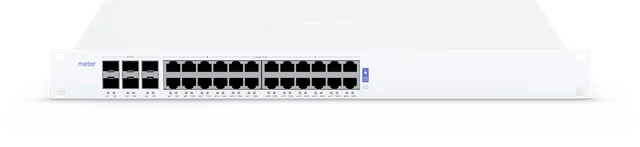
Meter S1 PoE++ access switch

PoE++ access switch

Meter S1

Best for: Powering Wi-Fi 7 APs and other PoE devices.

  • 24× 2.5GbE RJ-45 with PoE++
  • 6× 25G SFP28 uplinks
  • 720 W PoE budget; up to 60 W per port
  • 420 Gbps switching capacity
Datasheet (PDF) for Meter S1 (opens in a new tab)
Full specs 21 specification groups

Scroll for all specifications

Meter S1 full hardware specifications
Ports
  • 6× 25G (1G/10G/25G) SFP28
  • 24× 2.5GbE (2.5G/1G/100M/10M) RJ-45
Out-of-band management
  • 1× 1GbE (1G/100M/10M) RJ-45
Network standards
  • IEEE 802.3 10BASE-T
  • IEEE 802.3u 100BASE-TX
  • IEEE 802.3ab 1000BASE-T
  • IEEE 802.3z 1000BASE-SX
  • IEEE 802.3bz (2.5GBASE-T)
  • IEEE 802.3ae 10GBASE-X
  • IEEE 802.3by (25GBASE-R)
  • IEEE 802.3bt Type 3 (Class 6) for PoE++
Maximum VLAN ID
  • Up to 4096
Jumbo frame
  • Up to 10K bytes
MAC table Size
  • 32K
Packet buffer memory
  • 3MB
Audio (normal operating conditions)
  • 18dBA
MTBF
  • 305k hours
Hardware features
  • 6× 1/10/25G SFP28
  • 24× 10/100/1000/2500BASE-T
  • 1× OOB ports
  • Auto MDI/MDIX
  • Auto-negotiation
  • IEEE 802.3x flow control for full duplex operation
Power
  • 950W
  • Input voltage: 100-240V
  • Input frequency: 50-60Hz
  • Input current: 10A maximum at 115V/60Hz and 4.7 A maximum at 230V/50Hz
PoE capability
  • Up to 60W per port, 720 W power budget
Sensors
  • Temperature, Humidity, Power
LED indicators
  • 3 independent state LEDs (RGB+W)
Operation temperature
  • 0 ~ 45°C (32 ~ 113°F)
Humidity
  • Operation : 10 - 90% RH
  • Storage : 0 - 95% RH
Dimension (W × D × H)
  • 440 × 340 × 44 mm
Weight
  • 10.747 lbs / 4.87 kg
Certifications
  • US/CA, EU, UK
Compliance standards
  • EMC (Class A)
    • FCC 15B
    • ICES-003
    • CISPR32
    • CISPR35
    • CISPR24
    • EN 55032
    • EN 55035
    • EN 55024
    • EN 61000-3-2
    • EN 61000-3-3
Safety and restricted materials
  • CB and UL Safety
    • EN IEC 62368-1 edition 3
    • AS/NZS 62368.1
    • UL 62368-1 edition 3
  • RoHS
    • EN IEC 63000
Meter S2 multi-gigabit access switch

Multi-gigabit access switch

Meter S2

Best for: Dense wired offices and larger endpoint counts.

  • 48× 2.5GbE RJ-45
  • 6× 25G SFP28 uplinks
  • 540 Gbps switching capacity
  • 18 dBA in normal operating conditions
Datasheet (PDF) for Meter S2 (opens in a new tab)
Full specs 20 specification groups

Scroll for all specifications

Meter S2 full hardware specifications
Ports
  • 6× 25G (1G/10G/25G) SFP28
  • 48× 2.5GbE (2.5G/1G/100M/10M) RJ-45
Out-of-band management
  • 1× 1GbE (1G/100M/10M) RJ-45
Network standards
  • IEEE 802.3 10BASE-T
  • IEEE 802.3u 100BASE-TX
  • IEEE 802.3ab 1000BASE-T
  • IEEE 802.3z 1000BASE-SX
  • IEEE 802.3bz (2.5GBASE-T)
  • IEEE 802.3ae 10GBASE-X
  • IEEE 802.3by (25GBASE-R)
Maximum Vlans
  • Up to 4096
Jumbo frame
  • Up to 10K bytes
Unicast MAC address
  • 32K
Packet buffer memory
  • 3M bits
Audio (normal operating conditions)
  • 18dBA
MTBF
  • 688k hours
Hardware features
  • 6× 1/10/25G SFP28
  • 48× 10/100/1000/2500BASE-T
  • 1× Console
  • 1× OOB ports
  • Auto MDI/MDIX
  • Auto-negotiation
  • IEEE 802.3x flow control for full duplex operation
Power
  • Input voltage: 100-240V
  • Input frequency: 50-60Hz
  • Input current: 1.7A maximum at 115V/60Hz and 0.8A maximum at 230V/50Hz
Sensors
  • Temperature, Humidity, Power
LED indicators
  • 3 independent state LEDs (RGB+W)
Operation temperature
  • 0 ~ 45°C (32 ~ 113°F)
Humidity
  • Operation : 10 - 90% RH
  • Storage : 0 - 95% RH
Dimension (W × D × H)
  • 440 × 340 × 44 mm
Weight
  • 9.473 lbs / 4.297 kg
Certifications
  • US/CA, EU, UK
Compliance standards
  • EMC (Class A)
    • FCC 15B
    • ICES-003
    • CISPR32
    • CISPR35
    • CISPR24
    • EN 55032
    • EN 55035
    • EN 55024
    • EN 61000-3-2
    • EN 61000-3-3
Safety and restricted materials
  • CB and UL Safety
    • EN IEC 62368-1 edition 3
    • AS/NZS 62368.1
    • UL 62368-1 edition 3
  • RoHS
    • EN IEC 63000
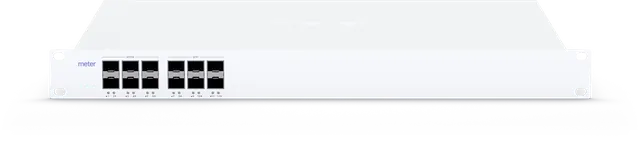
Meter S3 core and aggregation switch

Core / aggregation switch

Meter S3

Best for: Aggregating switches and fiber uplinks.

  • 6× 25G SFP28 + 6× 10G SFP+
  • 420 Gbps switching capacity
  • Dedicated 1GbE out-of-band management port
  • Silent in normal operating conditions
Datasheet (PDF) for Meter S3 (opens in a new tab)
Full specs 20 specification groups

Scroll for all specifications

Meter S3 full hardware specifications
Ports
  • 6× 25G SFP28
  • 6× 10G SFP+
Out-of-band management
  • 1× 1GbE (1G/100M/10M) RJ-45
Network standards
  • IEEE 802.3 10BASE-T
  • IEEE 802.3u 100BASE-TX
  • IEEE 802.3ab 1000BASE-T
  • IEEE 802.3z 1000BASE-SX
  • IEEE 802.3ae 10GBASE-X
  • IEEE 802.3× Flow control
  • IEEE 802.3by 25GBASE-R
Maximum VLAN ID
  • Up to 4096
Jumbo frame
  • Up to 10K bytes
Unicast MAC address
  • 32K
Packet buffer memory
  • 3M bits
Audio (normal operating conditions)
  • Silent
MTBF
  • 1M hours
Hardware features
  • 6× 1/10/25G SFP28
  • 6× 1/10G SFP+
  • 1× Console
  • 1× OOB ports
  • Auto MDI/MDIX
  • Auto-negotiation
  • IEEE 802.3x flow control for full duplex operation
Power
  • Input voltage: 100-240V
  • Input frequency: 50-60Hz
  • Input current: 1.7A maximum at 115V/60Hz and 0.8A maximum at 230V/50Hz
Sensors
  • Temperature, Humidity, Power
LED indicators
  • 3 independent state LEDs (RGB+W)
Operation temperature
  • 0 ~ 45°C (32 ~ 113°F)
Humidity
  • Operation : 10 - 90% RH
  • Storage : 0 - 95% RH
Dimension (W × D × H)
  • 440 × 340 × 44 mm
Weight
  • 8.675 lbs / 3.935kg
Certifications
  • US/CA, EU, UK
Compliance standards
  • EMC (Class A)
    • FCC 15B
    • ICES-003
    • CISPR32
    • CISPR35
    • CISPR24
    • EN 55032
    • EN 55035
    • EN 55024
    • EN 61000-3-2
    • EN 61000-3-3
Safety and restricted materials
  • CB and UL Safety
    • EN IEC 62368-1 edition 3
    • AS/NZS 62368.1
    • UL 62368-1 edition 3
  • RoHS
    • EN IEC 63000

Firewalls

Bring your business online with routing, perimeter security, and resilient connectivity.

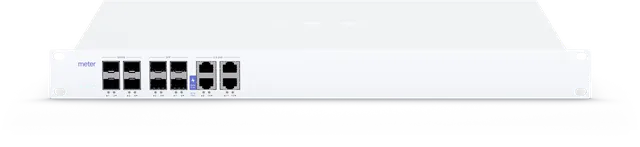
Meter F1 security firewall and router

Security firewall / router

Meter F1

Best for: Sites needing high-throughput routing and firewall security.

  • 50 Gbps firewall throughput
  • 4× 50G SFP56 + 4× 1G SFP + 4× 2.5GbE RJ-45
  • PoE+ output for Meter G1 cellular gateway
  • Redundant power supplies
Datasheet (PDF) for Meter F1 (opens in a new tab)
Full specs 15 specification groups

Scroll for all specifications

Meter F1 full hardware specifications
Ports
  • 4× 50G (1G/10G/25G/50G) SFP56
  • 4× 1G SFP
  • 4× 2.5GbE (2.5G/1G/100M/10M) RJ-45
Out-of-band management
  • Compatible with Meter 5G gateway
PoE capability
  • 1× PoE+ Out
Power
  • 2× 150W internal power supply
  • Input voltage: 100-240V
  • Input frequency: 50-60Hz
  • Input current: 1.7A maximum at 115V/60Hz and 0.8A maximum at 230V/50Hz
Audio (normal operating conditions)
  • 19dBA
MTBF
  • 549K hours
LED indicators
  • 3 independent state LEDs (RGB+W)
Sensors
  • Temperature, Humidity, Power
Operating environment
  • Temperature: 0 - 45°C (32 - 113°F)
  • Humidity: 5 - 95% RH
Storage environment
  • Temperature: -20 - 70°C (-4 - 158°F)
  • Humidity: 5 - 95% RH
Dimension (W × D × H)
  • 440 × 340 × 44 mm
Weight
  • 9.402 lbs / 4.265 kg
Certifications
  • US/CA, EU, UK
Compliance standards
  • EMC (Class A)
    • FCC 15B
    • ICES-003
    • CISPR32
    • CISPR35
    • CISPR24
    • EN 55032
    • EN 55035
    • EN 55024
    • EN 61000-3-2
    • EN 61000-3-3
Safety and restricted materials
  • CB and UL Safety
    • EN IEC 62368-1 edition 3
    • AS/NZS 62368.1
    • UL 62368-1 edition 3
  • RoHS
    • EN IEC 63000
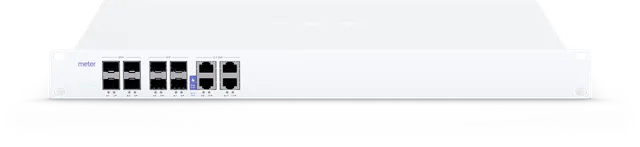
Meter F2 security firewall and router

Security firewall / router

Meter F2

Best for: Standard business deployments needing strong perimeter security.

  • 20 Gbps firewall throughput
  • 4× 10G SFP+ + 4× 1G SFP + 4× 2.5GbE RJ-45
  • PoE+ output for Meter G1 cellular gateway
  • Redundant power supplies
Datasheet (PDF) for Meter F2 (opens in a new tab)
Full specs 15 specification groups

Scroll for all specifications

Meter F2 full hardware specifications
Ports
  • 4× 10G (1G/10G) SFP+
  • 4× 1G SFP
  • 4× 2.5GbE (2.5G/1G/100M/10M) RJ-45
Out-of-band management
  • Compatible with Meter 5G gateway
PoE capability
  • 1× PoE+ Out
Power
  • 2× 150W internal power supply
  • Input voltage: 100-240V
  • Input frequency: 50-60Hz
  • Input current: 1.7A maximum at 115V/60Hz and 0.8A maximum at 230V/50Hz
Audio (normal operating conditions)
  • 17dBA
MTBF
  • 663K hours
Sensors
  • Temperature, Humidity, Power
LED indicators
  • 3 independent state LEDs (RGB+W)
Operating environment
  • Temperature: 0 - 45°C (32 - 113°F)
  • Humidity: 5 - 95% RH
Storage environment
  • Temperature: -20 - 70°C (-4 - 158°F)
  • Humidity: 5 - 95% RH
Dimension (W × D × H)
  • 440 × 340 × 44 mm
Weight
  • 9.402 lbs / 4.265 kg
Certifications
  • US/CA, EU, UK
Compliance standards
  • EMC (Class A)
    • FCC 15B
    • ICES-003
    • CISPR32
    • CISPR35
    • CISPR24
    • EN 55032
    • EN 55035
    • EN 55024
    • EN 61000-3-2
    • EN 61000-3-3
Safety and restricted materials
  • CB and UL Safety
    • EN IEC 62368-1 edition 3
    • AS/NZS 62368.1
    • UL 62368-1 edition 3
  • RoHS
    • EN IEC 63000
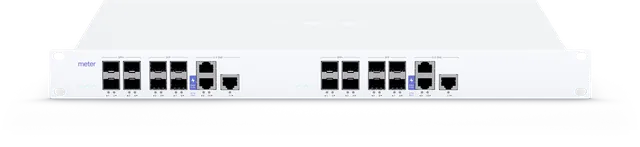
Meter F3 security firewall and router

Security firewall / router

Meter F3

Best for: Space-constrained sites needing a redundant firewall pair in one chassis.

  • 20 Gbps firewall throughput per firewall; dual-in-one HA chassis
  • Per firewall: 4× 10G SFP+ + 4× 1G SFP + 3× 2.5GbE RJ-45
  • PoE+ output for Meter G1 cellular gateway
  • Redundant power supplies
Datasheet (PDF) for Meter F3 (opens in a new tab)
Full specs 16 specification groups

Scroll for all specifications

Meter F3 full hardware specifications
Ports
  • 4× 10G (1G/10G) SFP+
  • 4× 1G SFP
  • 3× 2.5GbE (2.5G/1G/100M/10M) RJ-45
Built-in high availability (back-up ports)
  • 4× 10G (1G/10G) SFP+
  • 4× 1G SFP
  • 3× 2.5GbE (2.5G/1G/100M/10M) RJ-45
Out-of-band cellular
  • Compatible with Meter 5G gateway
PoE capability
  • 1× PoE+ Out for out-of-band, each
Power
  • 2× 150W internal power supply
  • Input voltage: 100-240V
  • Input frequency: 50-60Hz
  • Input current: 1.7A maximum at 115V/60Hz and 0.8A maximum at 230V/50Hz
Audio (normal operating conditions)
  • 19dBA
MTBF
  • 724K hours
Sensors
  • Temperature, Humidity, Power
LED indicators
  • 3 independent state LEDs (RGB+W)
Operating environment
  • Temperature: 0 - 45°C (32 - 113°F)
  • Humidity: 5 - 95% RH
Storage environment
  • Temperature: -20 - 70°C (-4 - 158°F)
  • Humidity: 5 - 95% RH
Dimension (W × D × H)
  • 440 × 340 × 44 mm
Weight
  • 10.69 lbs / 4.85 kg
Certifications
  • US/CA, EU, UK
Compliance standards
  • EMC (Class A)
    • FCC 15B
    • ICES-003
    • CISPR32
    • CISPR35
    • CISPR24
    • EN 55032
    • EN 55035
    • EN 55024
    • EN 61000-3-2
    • EN 61000-3-3
Safety and restricted materials
  • CB and UL Safety
    • EN IEC 62368-1 edition 3
    • AS/NZS 62368.1
    • UL 62368-1 edition 3
  • RoHS
    • EN IEC 63000

Power

Monitor and restart network equipment remotely, without a trip to the wiring closet.

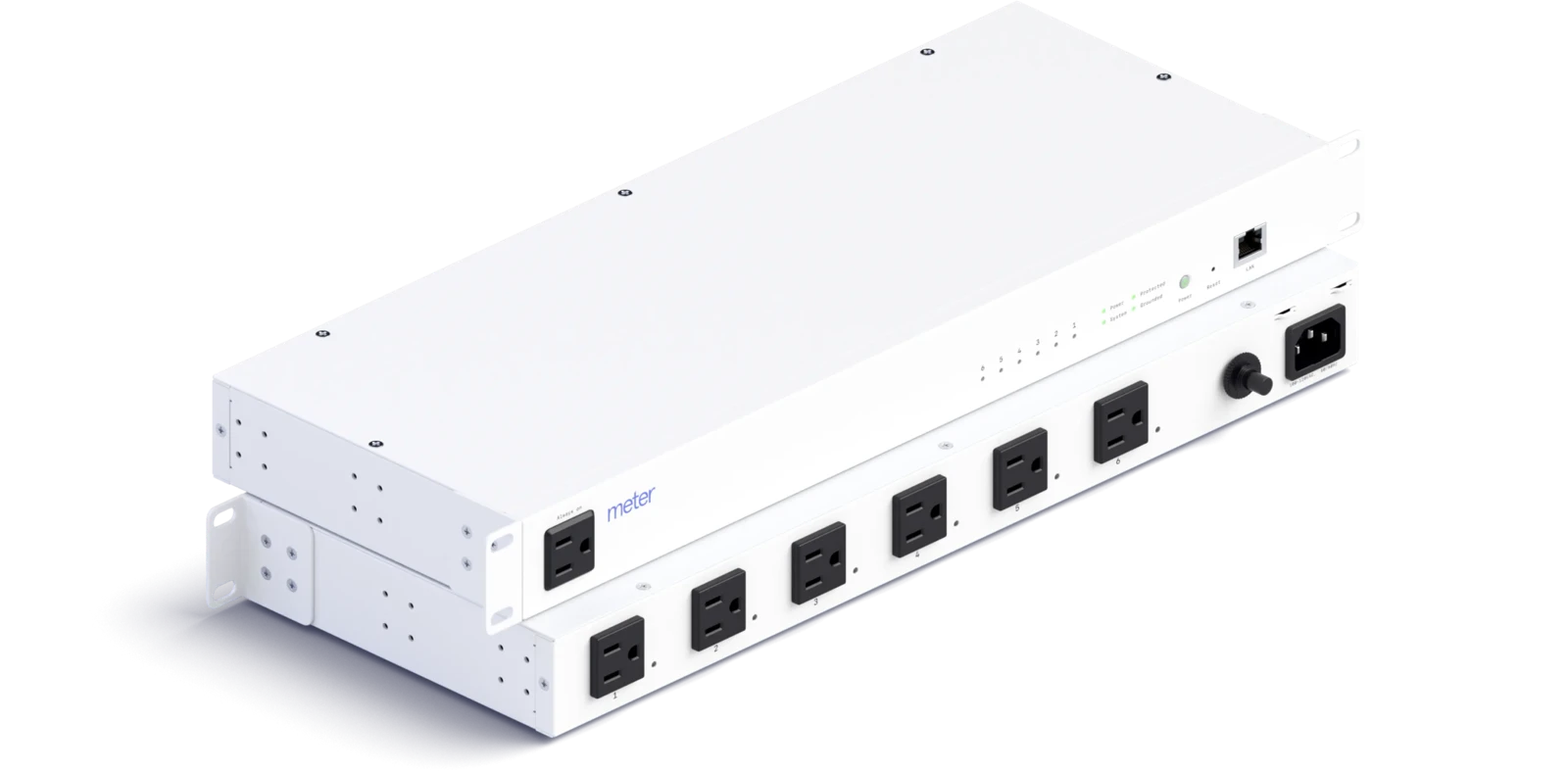
Meter 6-Outlet PDU

MP01 · Managed power · Available 2026

Meter 6-Outlet PDU

Best for: Remote power monitoring and cycling network equipment.

  • 6× NEMA 5-15R + 1× NEMA 5-15R bypass outlet
  • 100–120 V, 50–60 Hz; 15 A maximum input
  • 15 A overload breaker
  • 1× 10/100/1000 RJ45 management port
Datasheet (PDF) for Meter MP01 (opens in a new tab)
Full specs 3 specification groups

Scroll for all specifications

Meter MP01 full hardware specifications
Power specifications
  • Output:
    • 100~120V nominal voltage
    • 50-60 Hz frequency compatibility
    • Outlets:
      • (6) NEMA5-15R
      • (1) NEMA5-15R-Bypass
    • 15A breaker for overload protection
  • Input:
    • 100~120V nominal voltage
    • 15A maximum current
    • 50-60 Hz input frequency
    • Outlet:
      • (1) IEC C-14
Ethernet port
  • (1) 10/100/1000Mbps RJ45
  • 8P8C shielded RJ45 with LED (G/G)
Dimension (W × D × H)
  • 440 × 170 × 44 mm

Managed AC power, not a UPS or battery backup.

Cellular backup

Keep a second path to the internet when your primary connection is interrupted.

Meter G1 5G WAN backup gateway

5G WAN backup / out-of-band gateway

Meter G1

Best for: Cellular WAN failover, fast site turn-up and out-of-band management.

  • 5G Sub-6; Nano SIM + eSIM
  • 2× 2.5GbE RJ-45; PoE input
  • Over 1.2 Gbps throughput
  • IP67 for outdoors; −40 to 55°C
Datasheet (PDF) for Meter G1 (opens in a new tab)
Full specs 9 specification groups

Scroll for all specifications

Meter G1 full hardware specifications
Ports
  • 2× 2.5GbE (2.5G/1G/100M/10M) RJ-45
Cellular Spec
  • 5G Sub-6
Antenna
  • Internal: 4× 5G + 2× GNSS
SIM
  • Nano SIM + eSIM
Power
  • PoE In
Sensors
  • Temperature, Humidity
LED indicators
  • 3 independent state LEDs (RGB+W)
Operating environment
  • Temperature: -40°C to 55°C (-40°F to 131°F)
Dimension (W × D × H)
  • 177 × 177 × 46 mm

Models and specs from Meter; availability can change. Product images courtesy of Meter.

How it works

From the floor plan to a live, watched network.

Meter’s public “how it works” page and its deployment operations brief describe an end-to-end path: discover the space, design the network, install it, validate it, then operate it. Vega is the partner you talk to through that path.

Step 01

Discovery and site survey

Requirements and a survey of the actual space — offices are not warehouses, and no two floor plans are the same.

Step 02

Design and ISP planning

A custom wired and wireless design, plus ISP help if you want it: keep your current provider or have Meter source and coordinate a circuit.

Step 03

Install and cutover

Hardware is provisioned for your design. Full-service installs can include the IT closet, low-voltage cabling, and as many access points as the design needs. Old equipment can stay in place until the new network is tested. Meter also says it will buy back existing networking hardware and recycle it responsibly if you want that path.

Step 04

Validate, then operate

Configuration is validated before go-live. After that, Meter monitors the network, pushes software updates during a window you set, and includes hardware replacements and refreshes in the service.

How long a deployment takes

Meter’s deployment operations brief describes typical timelines of about six weeks for spaces under 250,000 square feet, and about eight weeks for larger sites. Two delivery paths exist: a partner-led install, where hardware ships for Vega or another installer to put in, and a Meter-led path that includes on-site installation and cabling. Which path a site uses is something we will confirm with you.

Buy-and-maintain vs. as-a-service

The usual network bill is a pile of invoices.

Meter’s CFO one-pager on network infrastructure costs puts the contrast in financial language, not slogans. Traditional networking, as Meter describes it, is fragmented and hard to forecast: high upfront hardware, separate licensing, consultants, installation, and vendor relationships that do not add up to one total. Meter’s alternative is a subscription with no upfront capital expenditure, a predictable monthly cost, and lifecycle management included.

A traditional purchase

  • Upfront capitalSwitches, access points, firewalls, and power are paid for at procurement, then start aging on day one.
  • Fragmented costLicensing, maintenance contracts, design consultants, and installers show up on separate bills.
  • Hard to forecastBreak-fix visits, refreshes, and after-hours work are easy to leave out of a first-year budget.
  • Staff timeSomeone still has to design, watch, patch, and replace the network — often an IT generalist who has other work.

What Meter says changes

  • Lower total cost of ownershipMeter states that its all-in-one model cuts costs across hardware, software, consultants, and installation, so internal teams can spend time on higher-value work.
  • Predictable costFixed fees with no upsells, and continuous product updates included.
  • Smoother cash flowA subscription avoids a large upfront purchase. Meter also notes that contracts can be structured under ASC 842 when a customer wants to capitalize the cost.
  • Refresh includedHardware upgrades are part of the service rather than a separate capital project years later.

Meter Connect

Internet service without a separate vendor chase.

Fast, reliable internet usually means comparing carriers, negotiating pricing, and chasing support when a circuit fails. Meter Connect folds procurement, circuit installation, monitoring, and support into the same service as the LAN.

Meter will assess the right level of service for each location — from broadband to multi-gig dedicated fiber — source quotes, negotiate, coordinate the install, watch the connection for outages, and resolve ISP tickets directly with carriers. Primary and backup circuits can be set up so a location stays up if one provider drops.

What you hand off

  • AssessmentThe right bandwidth and resiliency for each site, not a one-size circuit copied across locations.
  • Sourcing and installationMeter procures circuits and tracks the install from order to light-up.
  • Monitoring and supportOutages are watched end-to-end, from access point to carrier, instead of bouncing between your ISP and your network vendor.
  • One invoiceConnectivity can be billed alongside the Meter network, so the office WAN and LAN are not two unrelated contracts.

Meter Cellular — United States

Indoor cell coverage without a traditional DAS project.

Meter Cellular provides indoor cellular from the major carriers using neutral-host technology, so phones connect as they would to a nearby tower — no app, carrier profile, or captive portal. Meter compares this with active DAS (typically a 12-plus-month project on coax) and says its own installs run over CAT6 on a timeline of about four to six months. It also describes the work as having a smaller footprint and none of the ongoing carrier-coordination burden of active DAS.

This part of the stack is available in the United States. If indoor cellular matters for your site, we will tell you plainly whether it applies.

Where it is used

  • Hard-to-serve interiorsBasements, warehouses, and other spaces that outdoor towers do not reach well.
  • Operations that cannot drop callsMeter lists multi-site operations, logistics and manufacturing, and schools, healthcare, and hospitality — including coverage for scanners, robotics, and safety workflows.
  • Lifecycle includedMeter handles design, installation, operations, monitoring, and upgrades as bands, carriers, and radio technologies change.

Support

One place to call when the network misbehaves.

Meter describes support as a single point of contact, available from day zero, with both proactive and reactive help. Tickets can be filed from the dashboard. Support is offered by email, chat, and phone. Meter’s public support page states that 99.99% of issues are solved within 24 hours, and that its mean time to response is three times faster than legacy vendors. It also says it holds itself to published severity targets, from a full outage down to general questions.

Proactive

Continuous monitoring of hardware, software, and the network. Meter says machine learning is used to spot issues, alert its support team, and adjust settings before users feel the impact.

Reactive

When something does fail, Meter’s team steps in — and the dashboard also gives you quick checks such as flashing LEDs, a ping test, or cycling power if you want to try those first.

Always reachable

Think of it, in Meter’s words, as an internal team of networking engineers available 24/7. Backup LTE on the firewall means they can still troubleshoot if the ISP circuit is down. Software updates go out during off-hours you choose.

Network cost calculator

Compare buying and maintaining a network with Meter.

Walk through the costs of a traditional network — equipment, installation, software, maintenance, the people who run it, and break-fix visits — then compare that total with a Meter network delivered by Vega. Hardware, installation, software, support, and hardware refresh are treated as included on the Meter side. You still decide how much internal staff time remains.

Get Started

A few basics. We will add up costs over the window you choose.

Optional — used only to personalize the summary.

Site setup
How many years should we project?

We will add up costs over this window.

The floor area the network would cover. Vega’s monthly rate is applied to this number. Change it to match your space.

Hardware refresh

The equipment you price on the next step is a purchase happening now — that is always counted. This is only about whether you would need to refresh part of it again before the window above ends.

Where Vega fits

Meter is the platform. Vega is the partner who delivers it.

Meter owns the hardware, the software, the supply chain, and product-level support. Vega designs the engagement around your sites, coordinates deployment, and stays on as the team you call first. You should not have to manage Meter as a fourth vendor next to your email, security, and internet providers.

That is the same role Vega plays across the rest of the stack: a single conversation for detection and response, email security, secure access, and the network.

  • Design with your floor plan, not a catalog page. We help translate user count, rooms, and how people actually work into a Meter design.
  • Deploy without making you the general contractor. Installation can be partner-led or Meter-led. Either way, Vega stays accountable for getting the site live.
  • Manage it as part of Cyber-as-a-Service. Front-line questions come to us. Product issues escalate to Meter. You have one place to start.
  • Built for companies with fewer than 250 users. The calculator on this page is there so you can see whether the as-a-service path is even in the right range before we quote a specific site.

Questions

Short answers

What is Meter network as a service?

Meter network as a service is a subscription in which Meter designs and builds the network hardware and software, then runs it as a service, covering Wi-Fi 7 access points, switches, firewall, power distribution, software, support, and hardware refresh. Vega designs, deploys, and manages that Meter network for businesses with fewer than 250 users.

What is included in the monthly service?

Hardware (access points, switches, firewall, and power where the design needs it), the Meter dashboard and Command, network security features such as DNS security, IDS/IPS, SD-WAN, and VPN, ongoing support and monitoring, and hardware replacements and refreshes. ISP sourcing through Meter Connect and indoor cellular in the United States can be part of the engagement when they apply. Exact scope is confirmed in your Vega quote.

Do we own the hardware?

No. Meter keeps ownership of the stack and delivers it as a service. That is why refresh and replacement are part of the subscription instead of a later capital purchase.

Can we keep our current internet provider?

Yes. Meter says it will work with your current ISP or help find another, and that it is ISP-agnostic. Vega can include that coordination when you want it.

Is Meter Cellular available everywhere?

No. Meter Cellular is offered in the United States. The rest of the Meter network stack is what we typically start with; indoor cellular is discussed when a US site needs it.

What happens when something fails or the hardware ages?

Replacements and refreshes are included in the service. Meter also describes neighboring access points increasing coverage if one unit fails, and software updates that go out during an off-hours window you choose.

Is the calculator a quote?

No. It is an estimate so you can compare a traditional buy-and-maintain path with Meter delivered by Vega. Estimate only. Your Vega quote may differ.

Is a Meter network secure?

Meter describes a next-generation firewall with a default-deny, zero-trust style posture, DNS security, intrusion detection and prevention, and WPA3 and 802.1X authentication options. Network security does not replace endpoint detection and response or email security, which protect laptops and inboxes.

Want a number for your actual floor plan?

Send us the basics — locations, approximate square footage, and what you run today — and we will follow up with a real quote.

Get a quote
Scroll to Top